
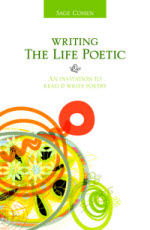
 I loved writing poems when I was growing up. Now, I only write them for special occasions like my husband’s milestone birthdays. Sage is the author of Writing the Life Poetic: An Invitation to Read and Write Poetry

Her equally talented friend and writer, Christina Katz, introduced us. I’m honored to have her as a guest here. Can you just see me doing my Barbara Walters pose and her sitting across from me?
How does poetry make the world a better place to live?
I think poetry fills the gap left by the so-called objective truth that dominates our media, science and legislation. Many of us want to comprehend and communicate the complexity of human experience on a deeper, more soulful level. Poetry gives us a shared language that is more subtle, more human, and–at its best–more universally “true” than we are capable of achieving with just the facts.
How has integrating the reading and writing of poetry into your life impacted you?
I will risk sounding melodramatic in saying that poetry saved my life. I stumbled into a writing practice at an extremely vulnerable time in my early teenage years. Poetry gave me then, as it does today, a way of giving voice to feelings and ideas that felt too risky and complicated to speak out loud.
There was a kind of alchemy in writing through such vulnerabilities…by welcoming them in language, I was able to transform the energies of fear, pain and loneliness into a kind of friendly camaraderie with myself. In a way, I wrote myself into a trust that I belonged in this world.
Do people need an advanced degree in creative writing in order to write poetry?
Absolutely not! Sure, poetry has its place in the classroom; but no one needs an advanced degree in creative writing to reap its rewards. What most people need is simply a proper initiation. I wrote Writing the Life Poetic to offer such an initiation. My goal was that everyone who reads it come away with a sense of how to tune into the world around them through a poetic lens. Once this way of perceiving is awakened, anything is possible!
Why did you write Writing the Life Poetic?
While working with writers for the past fifteen years, I have observed that even the most creative people fear that they don’t have what it takes to write and read poetry. I wrote Writing the Life Poetic to put poetry back into the hands of the people––not because they are aspiring to become the poet laureate of the United States––but because poetry is one of the great pleasures in life.
Who is Writing the Life Poetic written for?
Practicing poets, aspiring poets, and teachers of writing in a variety of settings can use Writing the Life Poetic to write, read, and enjoy poems; it works equally well as a self-study companion or as a classroom guide. Both practical and inspirational, it will leave readers with a greater appreciation for the poetry they read and a greater sense of possibility for the poetry they write.
What sets Writing the Life Poetic apart from other poetry how-to books?
The craft of poetry has been well documented in a variety of books that offer a valuable service to serious writers striving to become competent poets. Now it’s time for a poetry book that does more than lecture from the front of the classroom. Writing the Life Poetic was written to be a contagiously fun adventure in writing.
Through an entertaining mix of insights, exercises, expert guidance and encouragement, I hope to get readers excited about the possibilities of poetry––and engaged in a creative practice. Leonard Cohen says: “Poetry is just the evidence of life. If your life is burning well, poetry is just the ash.” My goal is that Writing the Life Poetic be the flame fueling the life well lived.
Is it true that your book and your baby were conceived and birthed at the same time? What did you learn from this process?
Yes, I often refer to my son Theo and Writing the Life Poetic as my multi-media twins! I found out I was pregnant with Theo about two months into the writing of the book and I was making final edits to the book in layout two weeks after he was born.
It was fascinating to have two of the most potent creative processes I’ve ever experienced happening in tandem. What I learned is a great respect for the birthing journey; it is one that has completely rewritten me along the way.
I am writing a monthly column this year for The Writer Mama zine titled “The Articulate Conception” which chronicles my journey of becoming an author and a mom. Through the course of ten essays, I am exploring this double-whammy birth trajectory–from the twinkle in my eye to the bags under my eyes. The first column is available here.
What makes a poem a poem?
This is one of my favorite questions! I’ve answered it in my book, but it’s a question that I’m answering anew every day. And that’s what I love about poetry. It’s a realm where invention is not limited entirely by definition; there is room enough for the endless possibilities of the human.
Every time we try to draw a line around what a poem is, something spills over into the next frame, shifting the point of view and demanding new names: olive, token, flax, daffodil. A poem is all of these, or none of them, depending on the quality of light and how the blade in the next room stirs the night.
What do you think people’s greatest misperceptions are about poetry?
I think the three greatest stereotypes about the writing of poetry are:
- That one has to be a starving artist or deeply miserable to write great poetry.
- That reading and writing poetry are available only to an elite inner circle that shares secret, insider knowledge about the making of poems.
- That poetry does not fund prosperity.
I hope very much that Writing the Life Poetic helps offer alternatives to some of these attitudes and perceptions.
Why is National Poetry Month (April) a great time to read and write poetry?
Every month is a great time to read and write poetry! But National Poetry Month is special because there are a number of inspiring opportunities to read and write in virtual tandem with poets everywhere, which creates a feeling of momentum and community. On my blog, I have a brief list of some fun ways to plug into the fun.
I’d love to conclude with a poem of yours. Would you be willing to share one?
Of course! Happy to!
Leaving Buckhorn Springs
By Sage Cohen
The farmland was an orchestra,
its ochres holding a baritone below
the soft bells of farmhouses,
altos of shadowed hills,
violins grieving the late
afternoon light. When I saw
the horses, glazed over with rain,
the battered old motorcycle parked
beside them, I pulled my car over
and silenced it on the gravel.
The rain and I were diamonds
displacing appetite with mystery.
As the horses turned toward me,
the centuries poured through
their powerful necks and my body
was the drum receiving the pulse
of history. The skin between me
and the world became the rhythm
of the rain keeping time with the sky
and into the music walked
the smallest of the horses. We stood
for many measures considering
each other, his eyes the quarter notes
of my heart’s staccato. This symphony
of privacy and silence: this wildness
that the fence between us could not divide.
Thanks for visiting, Sage!
About Sage Cohen
 Sage Cohen is the author of Writing the Life Poetic: An Invitation to Read and Write Poetry
What questions do you have about poetry? If you write poetry, why do you do it?
Great interview and beautiful poem.
I like how poetry can be so evocative … little chunks of prose that make you feel.
J.D. Meier´s last blog post… The Quest for Personal Power
How does poetry make the world a better place to live?
No other form of literature is able to stir emotions like a poem can.
A poem has a more intimate relationship with its reader.
When you read a poem you’re 100% focused on it’s meaning. Good or bad, happy or sad.
A poem can convey all these feelings in a more intense way than a book or song ever could.